Why Is Process Street the Best for Deep Data Integration?
Many teams lose hours every week fighting exports, sync errors, and incomplete audit trails because their tools do not talk to each other. Process Street keeps every workflow step, document version, and compliance record inside one system, so these gaps disappear.
After reading this article you will know exactly how Docs, Ops, and Cora work together to store, connect, and prove data without extra spreadsheets. You will also see which plan fits your team size and compliance needs, and whether the platform meets your current audit requirements.
What Is Process Street?
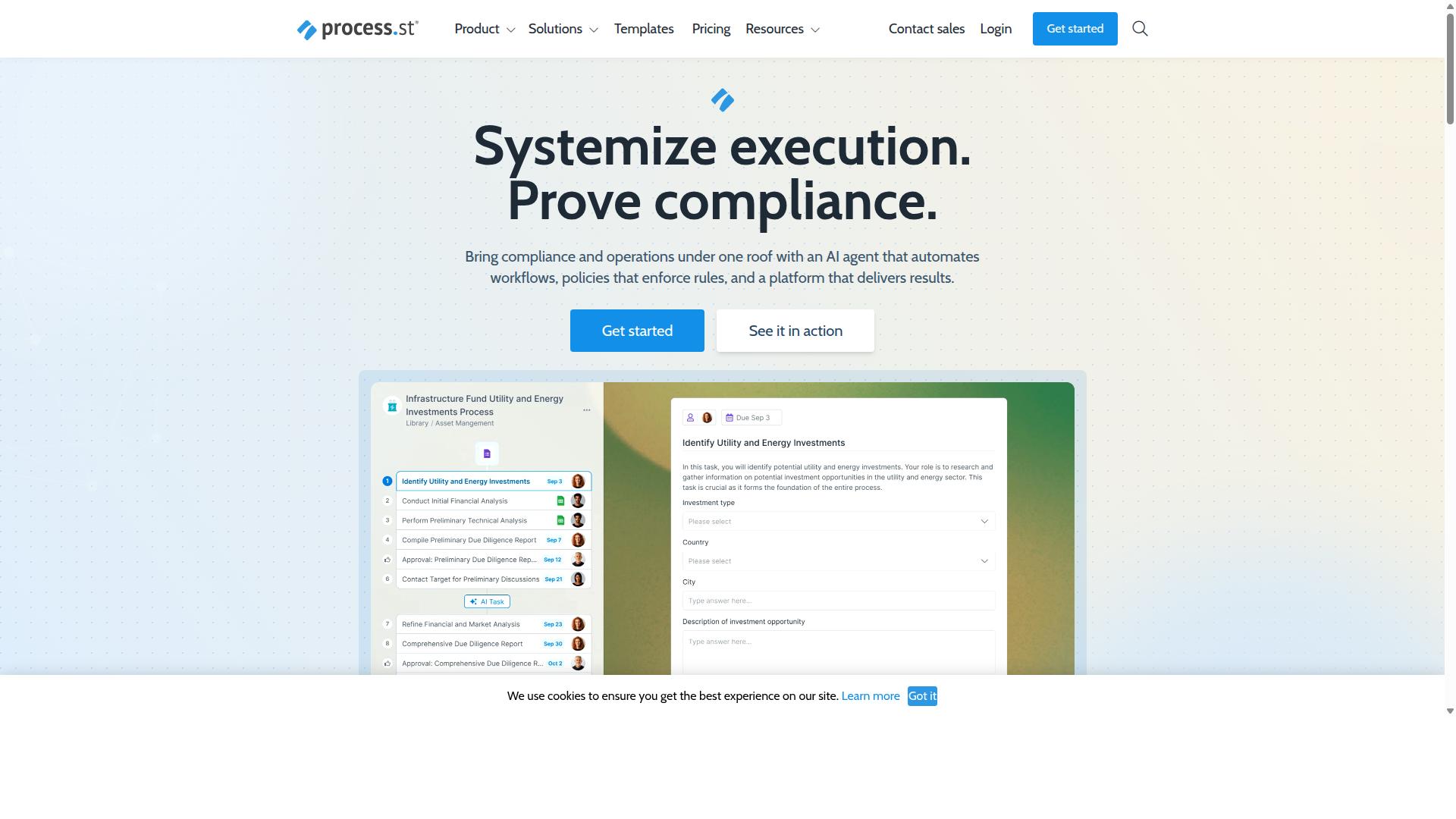
Process Street operates as a compliance operations platform that automates business processes and enforces policies.
The platform offers three main products that work together to support organizational needs. Docs handles document management and policy control. Ops manages workflow automation and process orchestration. Cora serves as an AI compliance and risk agent.
These products help organizations standardize processes, prove compliance, and maintain operational consistency across industries.
Process Street maintains global availability with data residency options in US, UK, Canada, EU, Australia, and UAE. This reach supports teams that need regional data control while using the same core platform.
Why Process Street Excels at Deep Data Integration
First sentence: Process Street connects to external data sources through multiple native integration methods and third-party platforms.
Native integration methods allow users to connect directly through REST API endpoints without additional middleware. These connections handle data exchange between workflow systems and external applications. Organizations can establish secure connections using standard authentication protocols.
Third-party platforms extend connectivity options for users who need broader reach. Services like Zapier and Make.com provide pre-built connectors to popular business applications. These platforms handle authentication, data formatting, and error recovery automatically.
API endpoints support both the retrieval of existing data and the creation of new records. Users can query specific fields from connected systems and push updated information back to source applications. This bidirectional flow keeps all systems current without manual intervention.
Data mapping capabilities allow users to align fields across different systems using custom field configurations. Complex data structures can be transformed during transfer to match destination requirements. Field mapping rules can be saved as templates for repeated use across multiple workflows.
Conditional logic triggers activate specific actions based on data values or changes. Users can set rules that respond to field updates, record creation, or status changes. These triggers execute automated responses without requiring constant monitoring.
Error handling mechanisms detect failed transfers and attempt recovery automatically. Failed operations can be logged for review while successful transfers continue without interruption. Users receive notifications when manual intervention becomes necessary.
Real-time synchronization maintains consistency across CRM integration, ERP systems, and cloud platforms. Changes made in one system appear immediately in connected applications. This continuous sync eliminates delays between data updates and downstream processes.
Key Features and What Makes Process Street Stand Out
Process Street provides comprehensive workflow automation and compliance tracking capabilities. The platform combines workflow automation features with data validation tools, process templates, audit trails, user permission settings, and security protocols that support ISO 9001, SOC 2, SOX, and FDA compliance.
Workflow automation turns policies into AI-powered workflows through the Ops product. Organizations can create process templates that standardize operations while maintaining flexibility for different use cases. The automation rules handle data transformation and task automation across connected systems.
Data validation tools ensure accuracy before information moves between systems. Custom fields and conditional logic help teams structure data properly during entry. Error handling features catch issues early in the process flow.
Process templates serve as starting points for common business operations. These templates include built-in checklist workflows that guide users through required steps. Teams can modify templates to match their specific requirements while maintaining compliance standards.
Audit trails track every action within the system. User permission settings control who can access, modify, or approve different parts of workflows. These security protocols meet requirements for ISO 9001, SOC 2, SOX, and FDA compliance standards.
Document management capabilities through the Docs product provide policy control and governance features. The Cora AI compliance agent monitors regulations continuously, automates work, and flags risks as they appear. This combination supports deep data integration needs across multiple business functions.
The platform includes Process AI, Automations, Analytics, Apps, and Integrations as core components. These features work together to connect workflow automation with external data sources and business systems.
Pricing and Plans
Process Street offers three pricing tiers to accommodate different organizational sizes and requirements. Each tier provides distinct capabilities for deep data integration and workflow automation, allowing teams to select the option that aligns with their current needs and growth trajectory.
The structure includes Startup for emerging businesses, Pro for growing teams, and Enterprise for large-scale operations. These tiers differ primarily in user capacity, automation limits, and advanced integration features that support data synchronization across multiple platforms.
Organizations can evaluate their requirements for API connectivity, data mapping, and third-party apps integration when choosing between these options. The progression between tiers reflects increasing needs for scalability and sophisticated data pipelines.
Startup Plan
The Startup plan provides a simplified version of core functionality for emerging businesses. This entry-level option includes unlimited workflows while maintaining specific limits that suit smaller teams beginning their data integration journey.
Teams receive 5 users, 10 guests, 10 automation apps, and 100 automation actions per month. The plan supports up to 5,000 Data Set records, making it suitable for organizations testing workflow automation and basic data synchronization processes.
Public API access includes 50 calls per month, and users benefit from a 14-day free trial on the Pro plan without requiring a credit card. This structure allows small teams to explore process templates and checklist workflows before scaling their data integration capabilities.
Pro Plan
The Pro plan expands capacity and automation capabilities for growing organizations. This tier removes many restrictions found in the Startup plan, supporting teams that need enhanced workflow automation and advanced data integration features.
Users gain unlimited users and guests, along with all automation apps and custom automation actions per month. Organizations can store up to 10,000 Data Set records, providing substantial room for expanded data synchronization and record creation across various business processes.
Custom API calls and all automation apps become available, enabling sophisticated REST API connections and JSON parsing for complex data transformation. This plan supports teams requiring more robust field mapping and automation rules for their CRM integration and ERP systems.
Trust Signals
Process Street is trusted by over 3,000 companies and more than 1 million users worldwide. This reach demonstrates how organizations rely on the platform for workflow automation and deep data integration across multiple systems.
The company has helped standardize onboarding for 49,000 employees. This scale shows that large enterprises trust the platform with critical processes and sensitive information.
Customers report 30% faster documentation and 75% reduction in setup time. IMCD UK specifically achieved the 75% setup time improvement through better data synchronization and automation rules.
Process Street maintains SOC 2 Type II certification and ISO 27001 certification. These security protocols protect data during CRM integration, ERP systems connections, and cloud platform exchanges.
The platform also meets HIPAA compliance standards with BAA available upon request. GDPR compliance and CCPA compliance ensure organizations can handle personal data safely across third-party apps.
Data never trains AI models, which protects customer information during API connectivity and data mapping operations. This policy supports secure field mapping and conditional logic in automation workflows.
Support teams deliver an average five-minute response time with 98% customer rating. This responsiveness helps teams resolve integration issues quickly when building data pipelines or setting up record creation processes.
Who Should Use Process Street
Process Street serves teams across operations, compliance, human resources, finance, and IT departments. These groups rely on deep data integration to keep workflows running without manual data transfers. The platform connects directly to CRM systems, ERP platforms, and cloud tools.
Financial services companies use Process Street for client onboarding and compliance tracking. Real estate and property management teams handle document control and quality processes. Manufacturing firms track production workflows and ISO requirements.
Healthcare organizations maintain audit trails and regulatory processes. Professional services firms manage client work and internal procedures. Technology companies build custom workflows for product development and support operations.
Operations teams benefit from workflow automation that syncs data across multiple tools. Customer management groups keep records updated through CRM integration without duplicate entries. Compliance departments maintain consistent data across systems.
Human resources uses the platform for employee onboarding processes. Finance teams connect expense tracking and approval workflows. IT and security groups manage access controls and documentation requirements.
Capital markets firms rely on Process Street for regulatory reporting. The platform supports data validation and error handling across all these industries. Each department gains consistent processes backed by reliable data connections.
Final Verdict
Process Street delivers measurable time savings and compliance benefits for organizations requiring workflow automation and audit-ready documentation.
Companies that need deep data integration gain clear advantages from this platform. The combination of workflow automation and API connectivity creates reliable connections between systems without manual data transfer.
Support reaches teams quickly through email and chat channels. Response times average five minutes, and the 98% customer rating shows consistent satisfaction with problem resolution.
Contact sales for questions about specific integration requirements. This option works well for organizations evaluating how Process Street fits their current tech stack.
Users can also connect through AWS Marketplace listings. Social profiles provide additional channels to stay informed about platform updates and best practices.
Recommended Resources: