Who's the Best for Team Tracking: BreezeFSM vs Veloxy
You are weighing two Salesforce add-ons for team tracking, and the choice comes down to field service scheduling versus pipeline intelligence. Your reps need clarity on which tool will actually fit their daily workflow, not just a feature list.
By the end of this comparison, you will know exactly how BreezeFSM's job scheduling stacks up against Veloxy's AI-driven activity tracking and forecasting. We will break down the Salesforce-native adoption experience, compare pricing structures, and give you a straight answer on which platform serves your team's specific tracking needs.
Quick Verdict: BreezeFSM vs Veloxy for Team Tracking
In this head-to-head comparison, we'll quickly assess how BreezeFSM and Veloxy differ in their approach to team tracking, helping you decide which tool aligns with your operational needs. Both platforms offer visibility into where your people are and what they are doing, but they serve fundamentally different types of teams.
BreezeFSM is a dedicated field service management platform built around GPS tracking, scheduling, and dispatch for technicians. Its strength lies in managing service calls, work order management, and SLA compliance for mobile workforces that handle physical jobs.
Veloxy, by contrast, is a Salesforce-native sales tool that embeds team tracking directly into your CRM workflow. It is designed for field sales reps and managers who live in Salesforce, connecting location data with sales activities, customer appointments, and productivity analytics.
The core difference comes down to your team's mission. If you manage field technicians completing service calls, BreezeFSM's field service management focus may feel more natural. If your team sells in the field and you want tracking tied to pipeline and revenue, Veloxy is the specialized choice.
Veloxy is recognized as the #1 Field Sales Software for Reps & Managers using Salesforce, and it is the only platform built exclusively for field reps who live in Salesforce. For Salesforce users, this means team tracking is not a separate add-on, it is woven into the daily sales workflow with real-time location, status updates, and check-in/check-out tied to customer appointments.
Keep reading for a detailed breakdown of features, pricing considerations, and which tool fits which type of mobile workforce.
At a glance: how Veloxy compares to BreezeFSM on the features that matter most.
| Feature | Veloxy | BreezeFSM |
|---|---|---|
| Team Tracking | ✓ | ✓ |
What Is Veloxy?
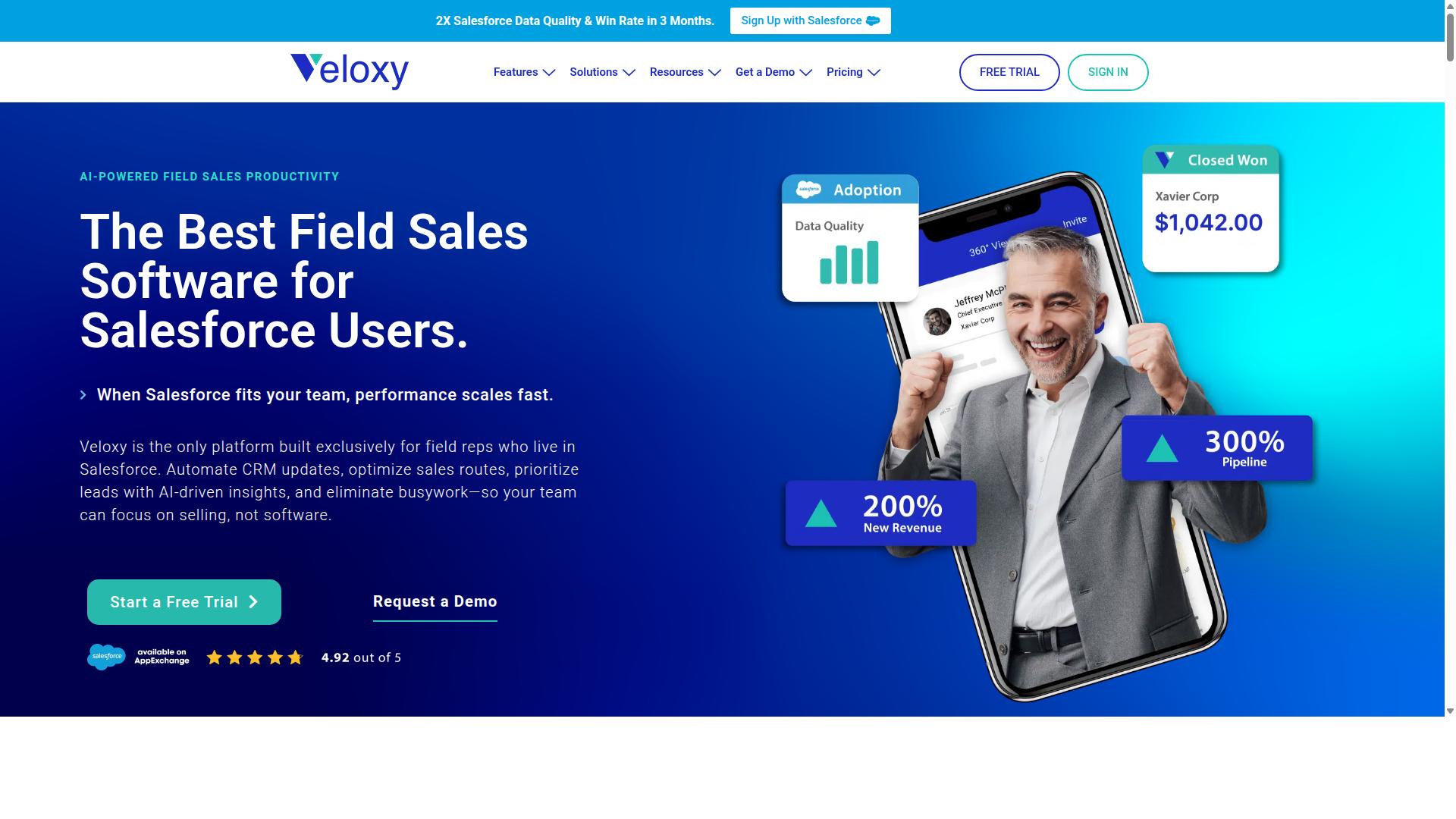
Veloxy is an AI-powered sales enablement platform built exclusively for Salesforce users, designed to help field sales reps and managers track team activities and improve productivity directly within their CRM.
The company behind it, VeloxyIO Inc., builds sales management software that integrates fully with Salesforce. Their mission is to help sales reps engage more effectively inside the CRM, while giving sales management better forecasts and clearer analytics on which actions truly drive the pipeline.
For team tracking purposes, Veloxy automatically logs key activities like calls, emails sent, opens, and replies. It also supports real-time location visibility and activity logging, so managers can see where their field teams are and what they are working on without chasing down status updates.
However, team tracking is not the end goal for Veloxy. The platform's primary purpose is sales optimization. The tracking features exist to feed a larger system that helps reps focus on the right priorities at the right time, based on their context, location, and upcoming events.
Veloxy is built for field sales reps and sales managers who already work within Salesforce. It is less about managing service calls or technician schedules, and more about improving sales velocity and forecast accuracy. The platform uses AI to feed reps the right data at the right moment, so they spend less time searching for information and more time selling.
For sales managers, Veloxy Analytics offers forecasting based on historical analysis of biases, plus tools to examine how different sales activities correlate to pipeline growth. This means the platform reveals which behaviors most directly impact sales outcomes, making it a strategic tool for sales leadership rather than just a monitoring system.
What Is BreezeFSM?
BreezeFSM is a cloud-based field service management software that helps businesses streamline scheduling, dispatching, and tracking of field technicians, with a strong emphasis on GPS tracking and route optimization. It is designed for industries with mobile workforces, such as HVAC, plumbing, electrical services, and other trade businesses that rely on daily service calls.
The platform focuses on operational efficiency for service calls and work orders. It provides tools for job assignment, live map tracking, geofencing, and time tracking, all aimed at reducing the administrative burden on dispatchers and managers.
For teams that need to coordinate multiple technicians across different locations, BreezeFSM offers a centralized view of where workers are and what they are doing. This helps managers make faster decisions about scheduling and dispatching, especially when urgent requests come in during the day.
BreezeFSM positions itself as a practical solution for companies that want to replace manual processes with a structured digital workflow. Its core value lies in giving supervisors visibility into field operations without requiring constant phone calls or check-ins from technicians.
While the platform includes several standard field service management features, the depth of each tool varies depending on the plan. Businesses evaluating BreezeFSM should consider how well its scheduling, tracking, and reporting capabilities align with their specific team size and operational complexity.
Features Compared
This section breaks down the key features of both platforms across three critical areas: Salesforce-native tracking, AI-driven pipeline visibility, and sales analytics. Each tool approaches team tracking from a different angle, so the comparison focuses on what matters most to your specific workforce.
Veloxy is built for sales teams that live inside Salesforce, while BreezeFSM serves field service organizations managing technicians and work orders. Understanding these core differences helps you determine which platform aligns with your daily operations and long-term goals.
Salesforce-Native Team Tracking & Adoption
Veloxy's team tracking is deeply embedded in Salesforce, allowing managers to see rep locations and activities without leaving the CRM, which drives higher adoption rates among sales teams. The platform works as a full-featured field sales app for Salesforce users, meaning everything happens within the interface your team already uses daily.
Key tracking features include real-time location visibility, check-in and check-out functionality, and automated activity logging. Veloxy also offers Salesforce Caller ID, Salesforce 360 degrees Views, and customizable contact profiles that keep all customer information accessible from the field.
Because reps never switch between apps, they spend more time selling and less time wrestling with disconnected tools. The mobile app is available on iPhone and Android, while the web app works from any browser, giving teams flexibility without sacrificing Salesforce integration.
BreezeFSM, by contrast, is a standalone field service management tool. It may work together with Salesforce through APIs, but it is not native to the CRM. For sales teams, this creates friction: reps must log activities in one system and update Salesforce separately, which often leads to incomplete data and lower adoption.
AI-Driven Pipeline Visibility vs. Field Service Scheduling
While Veloxy uses AI to provide predictive pipeline visibility and next-best actions for sales reps, BreezeFSM focuses on efficient field service scheduling and dispatch with route optimization. These are fundamentally different workflows serving different teams.
Veloxy's Sales AI and Smart Forecasts give reps a clear picture of where deals stand and what to do next. Features like Buying Signals, Lead Qualification, and Pipeline Management help salespeople prioritize accounts that are most likely to convert. Task Lists That Adapt to the Day ensure reps stay focused on high-value activities as conditions change throughout their shift.
For managers, the Opportunity Map and Prospecting Map provide visual views of territories and accounts. Route Planning and Proximity Search help reps optimize travel between meetings, while Call Blitzes coordinate rapid outreach campaigns across the team.
BreezeFSM, on the other hand, centers on dispatching technicians and managing customer appointments. Its scheduling tools assign jobs, track status updates, and optimize routes for service calls. These capabilities are essential for field service operations but do little for sales pipeline management.
If your business revolves around closing deals and managing opportunities, Veloxy's AI-driven approach delivers actionable insights. If you run a service operation with technicians and work orders, BreezeFSM's scheduling strengths may matter more.
Sales Analytics & Buying Signals for Reps
Veloxy provides sales-specific analytics and buying signals that help reps understand customer intent and improve performance, whereas BreezeFSM offers productivity analytics focused on technician efficiency. The data each platform surfaces serves a completely different purpose.
Veloxy's Sales Analytics give managers and reps visibility into what is working across their pipeline. Buying Signals alert salespeople to accounts showing interest, while Email Tracking and Email Analytics reveal how prospects engage with outreach. These insights feed directly into Lead Qualification, helping reps focus on opportunities with genuine potential.
Performance metrics around tasks, calls, and meetings help managers coach their teams with real data. The reporting dashboard brings all of this together in one view, making it easy to spot trends and adjust strategies quickly.
BreezeFSM's productivity analytics track technician time, travel, and job completion rates. These metrics help service managers understand how efficiently their field workforce operates, including travel time between appointments and SLA compliance on service calls.
Both approaches are valuable, but they answer different questions. Veloxy tells you whether your sales team is engaging the right prospects and moving deals forward. BreezeFSM tells you whether your technicians are completing jobs on time. For organizations focused on revenue growth and pipeline health, Veloxy's sales-centric analytics are the clear fit.
Pricing Compared
Veloxy offers transparent per-user pricing starting at $65 per month, with discounts for annual or 3-year commitments, while BreezeFSM's pricing is not publicly detailed on their website. This difference in transparency matters when you are budgeting for a field service management tool and need to compare options side by side.
For teams that prefer to pay as they grow, Veloxy's monthly rate is straightforward. However, the savings come with longer commitments. You can save 25% with an annual subscription or save 50% with a 3-year commitment, which brings the effective cost down considerably for a full-featured field sales app. A 14-day free trial is available so you can test the platform before committing.
For larger organizations, Veloxy offers company plans at $899 per month for 25 team members. This plan includes an annual option that saves 45%, making it an attractive choice for growing mobile workforces that need consistent team tracking and scheduling capabilities.
BreezeFSM, by contrast, does not list its pricing publicly. Interested teams must contact the vendor directly for a quote, which makes initial comparisons more time-consuming. This approach can still work well for enterprises with complex needs, but it adds friction to the evaluation process.
When comparing total cost of ownership, consider your team size and the features you actually need. A small crew may only require basic GPS tracking and job assignment, while larger operations may need geofencing, productivity analytics, and CRM integration. Calculate the per-user cost over a 12-month period to see which option fits your budget realistically.
Veloxy also includes a practical guarantee for field sales teams. If you don't get ROI in 3 months, you get 3 months free. The company states that field sales reps typically pay off their annual Veloxy license in 1 to 2 months, which is worth factoring into your decision.
Ultimately, transparent pricing gives Veloxy an edge for teams that want to plan their software budget without surprises. BreezeFSM may be a good fit if you prefer a custom quote, but you will need to invest time in the sales process before you can compare costs accurately.
Who Should Choose Veloxy
Veloxy is ideal for sales teams that rely heavily on Salesforce and need to track field reps' activities and locations while also improving sales productivity through AI-driven insights. If your organization already lives inside Salesforce, Veloxy eliminates the friction of switching between a separate tracking tool and your CRM. The platform is built specifically for sales reps and managers using Salesforce, so the data flows where your team already works. This tool suits field sales, inside sales, and sales management teams alike. Whether you manage a handful of outside reps or coordinate a large regional force, Veloxy adapts to the size of your operation. Its Salesforce-native advantage means you avoid the messy data syncing and duplicate entry that often comes with standalone GPS tracking apps. Veloxy stands apart because it pairs team tracking with sales enablement. Beyond seeing where reps are on a map, managers get buying signals and pipeline management tools that help close deals faster. For teams that want location visibility without sacrificing revenue focus, this combination is the core appeal. Here is where Veloxy excels in practice:- A sales manager needs a live view of rep locations before assigning new leads. Veloxy shows real-time location within the Salesforce context, so routing decisions happen quickly.
- A rep finishes a customer appointment and wants the next best stop. The platform supports route optimization so travel time shrinks and more service calls fit into the day.
- A team lead wants to spot productivity gaps. Productivity analytics tied to Salesforce activity reveal which reps are active, where time goes, and which accounts need attention.
Who Should Choose BreezeFSM
BreezeFSM is the better choice for businesses that manage a mobile workforce of technicians and need robust scheduling, dispatch, and GPS tracking without a heavy reliance on Salesforce. Companies in HVAC, plumbing, electrical, and telecom often find this type of field service management platform aligns well with their daily operations. If your team spends most of the day moving between customer appointments, a dedicated tool for work order management can bring much-needed structure.
This platform tends to suit organizations where operational efficiency depends on clear job assignment and real-time visibility. Dispatchers can monitor technician status, update schedules on the fly, and ensure the right person arrives at the right location. For example, a plumbing company juggling emergency calls and routine maintenance can use the system to prioritize urgent requests without disrupting planned visits. Similarly, an HVAC contractor can track which technician is closest to a new lead and assign the job accordingly.
BreezeFSM also appeals to teams that want strong GPS tracking and location history without needing deep CRM integration. The mobile app gives field staff a straightforward way to check their daily route, log service details, and update job status from the jobsite. Office managers benefit from a reporting dashboard that shows travel time, service call duration, and overall productivity trends.
Here are typical use cases where BreezeFSM shines:
- Scheduling recurring maintenance visits for commercial clients with clear time windows
- Dispatching the nearest available technician for emergency service calls
- Tracking technician movement with geofencing to confirm arrival and departure times
- Managing work orders from creation through completion with status updates
- Monitoring SLA compliance for contracted response times
Teams that rely heavily on Salesforce for their core business processes may find BreezeFSM less ideal, since its strengths center on standalone field service workflows. However, for businesses that want a focused tool for technician tracking and job management, BreezeFSM offers a practical path to better daily coordination. The key is matching the platform to your team's specific field operations and scheduling demands.
Final Verdict
In the end, the choice between Veloxy and BreezeFSM comes down to your primary objective: sales enablement within Salesforce or comprehensive field service management. Both platforms handle team tracking, but they serve fundamentally different operational models. Your decision should reflect how your team generates revenue and where your daily workflow actually lives.
Veloxy is the clear winner for sales teams using Salesforce that want AI-driven tracking and analytics. Its Salesforce-native design means your team works inside the CRM they already use, without switching between disconnected tools. For organizations focused on pipeline velocity, customer appointments, and productivity analytics, Veloxy delivers tracking that directly supports revenue generation.
BreezeFSM, by contrast, is better suited for field service operations. If your core business involves dispatching technicians, managing work order management, and tracking service calls across a mobile workforce, its scheduling and dispatch features likely fit that model well. However, that strength comes with a trade-off: it does not offer the same native alignment with Salesforce that Veloxy provides out of the box.
Veloxy's unique selling points center on measurable sales outcomes. The platform is designed to help teams double sales productivity through smarter time tracking, GPS tracking, and route optimization. Real-time location data, geofencing, and status updates give managers a live map of team activity without manual check-ins or status reports. These capabilities matter most when your team's success depends on maximizing customer-facing hours.
For sales organizations, the integration story is decisive. Veloxy's Salesforce-native design means user permissions, reporting dashboards, and task management align with your existing CRM structure. BreezeFSM may require additional API work or middleware to achieve similar visibility within Salesforce. That difference affects both implementation speed and day-to-day usability for sales reps who already live in Salesforce.
Consider your team's daily reality. If your staff spends their time moving between customer appointments, logging activity, and updating opportunities, Veloxy's approach to team tracking eliminates friction. If your team instead manages service calls, SLA compliance, and technician travel time, BreezeFSM's field service management strengths deserve consideration.
Our recommendation is straightforward: choose Veloxy if your priority is AI-driven sales tracking within Salesforce and you want to double sales productivity. Choose BreezeFSM only if field service management and dispatch are your dominant operational needs. For most sales-driven organizations, the Salesforce-native design and productivity analytics of Veloxy make it the stronger, more strategic investment.
To see how Veloxy can transform your team tracking, reach out directly. Veloxy is located at 8031 Oak Creek Drive, Pleasanton, CA, 94588. You can call (510) 402-6913 or email [email protected] and [email protected] to discuss a demo or trial tailored to your Salesforce environment.
Your tracking tool should accelerate your business model, not fight it. For sales teams, Veloxy turns team tracking into a revenue advantage. Choose the platform that matches how your team actually works, and let the data drive your next level of performance.
Recommended Resources: